EDS, hEDS, HSD: Why Your Body Feels Unstable and What You Can Do

Feeling unstable, weak, or like your joints don't movem the way they should? Learn about how EDS, hEDS, and HSD can affect movement, stability, pain, and your ability to feel confident in your body.
If you have joint pain, frequent injuries, clicking or popping joints, instability, or a body that seems to hurt “everywhere,” you may have wondered:
Could I have hypermobile Ehlers-Danlos syndrome (hEDS)?
Maybe you've been told you're “just flexible.”
Maybe you've had multiple injuries without a clear explanation.
Maybe you've tried stretching, strengthening, massage, chiropractic care, or traditional physical therapy—and somehow you still don't feel stable.
Or maybe you've been told you have hEDS based primarily on a high Beighton score, but you're still not sure what that actually means.
The good news is that you don't need to have all the answers before you start addressing the problems that are affecting your life.
Physical therapy can't change the connective tissue you were born with. But it can help you develop better strength, coordination, proprioception, endurance, and movement control so your muscles can do more of the work of stabilizing your body. Learning to use those muscles more efficiently can significantly improve stability, reduce unnecessary strain on the joints, and help many people move with less pain.
Let's break down what hEDS is, how it is diagnosed, and what I actually look for when working with someone who is hypermobile.
Hypermobile Ehlers-Danlos Syndrome (hEDS) vs Hypermobile Spectrum Disorder (HSD)
Hypermobile Ehlers-Danlos syndrome (hEDS) is a specific clinical diagnosis involving generalized joint hypermobility plus additional features and the exclusion of other conditions that can cause similar symptoms like the known 14 genetic types of Ehlers Danlos Syndrome, other genetic connective tissue disorders like Marfan, Loeys-Dietz syndrome or autoimmune disorders like Rhumetoid arthritis or lupus.
And then there is hypermobility spectrum disorder (HSD). HSD describes symptomatic joint hypermobility when someone does not meet the criteria for hEDS or another specific connective tissue disorder.
How do I know if I’m Hypermobile?
Step 1 is to use the Beighton Score to test for generalized hypermobility. The Beighton score is a simple 9-point test used to measure how flexible your joints are. It looks at a handful of joints that are easy to assess: your fingers, thumbs, elbows, knees, and spine. A higher score means you have more flexibility in these particular joints.
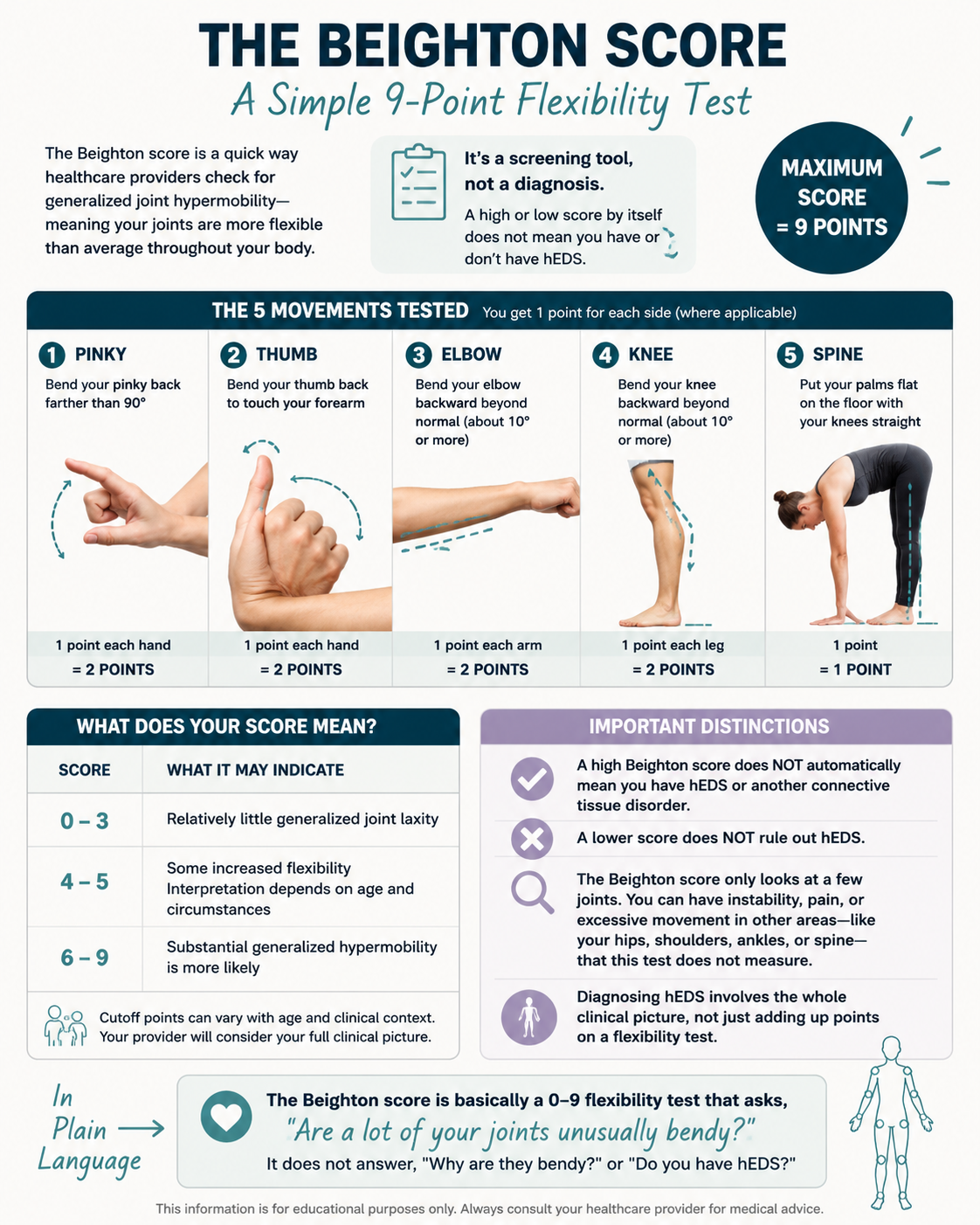
Up to puberty a positive score is 6 points. From puberty to 50 years old 5 points and older than 50 is 4 points
There isn't one single “hEDS body.” People can experience very different combinations of symptoms.
Common musculoskeletal problems can include:
Joint instability
Recurrent sprains or strains
Subluxations or dislocations
Chronic joint or muscle pain
Feeling like a joint is difficult to control
Muscle fatigue
Poor body awareness or proprioception
Frequent injuries
Clicking or popping
Difficulty maintaining posture
Feeling worse after prolonged activity
Difficulty recovering from exercise
Reduced tolerance for standing, walking, or other activities
Some people have obvious joint hypermobility.
Others don't look particularly flexible at first glance because their muscles have become very good at guarding and restricting movement.
That's one reason a single test doesn't tell the whole story.
The Beighton Score is only one aspect of diagnosing HSD or EDS
A high Beighton score ≠ automatically hEDS.
A lower Beighton score does not automatically explain away every hypermobility-related problem.
Pain, guarding, previous injuries, and adaptive stiffness can sometimes make joint hypermobility less apparent during screening. As such, being assessed by an experienced physical therapist is key to also take into account medical history, symptom behavior and other clinical signs included in the hEDS diagnostic checklist.
The Beighton score is a screening tool, not a diagnosis. A high score does not automatically mean you have hypermobile Ehlers-Danlos syndrome (hEDS), and a lower score does not automatically rule it out. The Beighton score also doesn't take into account every joint in your body. You can have significant instability or excessive movement in areas such as your hips, ribs shoulders, ankles, or spine without that reflecting in your score. That's why diagnosing hEDS involves looking at the whole clinical picture, not just adding up points on a flexibility test.
Why does hypermobile Ehlers-Danlos syndrome cause pain and instability?
One of the most common questions I hear from people living with hypermobile Ehlers-Danlos syndrome (hEDS) or hypermobility spectrum disorder (HSD) is:
"Why did this happen? Why is it so hard to hold myself up and move?"
The answer begins with collagen, the primary structural protein in your body's connective tissues. I often describe collagen as the body's duct tape because it helps hold everything together. It forms your ligaments, which connect bone to bone, your tendons, which connect muscle to bone, and provides much of the structure of your skin, muscles, blood vessels, and many other tissues. In short, collagen provides the framework that allows your body to stay stable while still being flexible.
In the different types of Ehlers-Danlos syndrome, genetic changes affect how collagen is made or how it is organized. You can think of these genes as the body's recipe book. When the recipe changes, the collagen that is produced may be stretchier or less mechanically efficient. As a result, the connective tissues throughout the body provide less structural support, making joints more prone to excessive movement and instability.
Ligaments help limit excessive joint movement, while tendons connect muscles to bones. When passive tissues provide less stability to joints, your muscles may have to do more of the work of controlling the joint. Over time, that can contribute to:
Fatigue → compensation → overload → pain → less activity → deconditioning → even less stability.
That's where physical therapy comes in. Hypermobility-focused PT shouldn't simply hand you a list of exercises and tell you to “push through it” to “get stronger.” True stability is the ability to control movement and respond to strength and posture control challenges without having to think about it. What needs to be considered in an effective corrective exercise prescription are:
Joint stability
Strength
Endurance
Proprioception
Breathing mechanics
Posture
Core control
Balance
Gait
Coordination between muscle groups
How you load your joints
How you compensate
How your other symptoms (like pain, dysautonomia) respond to exercise
The plan shoulde be built around your specific movement system. The Ehlers-Danlos Society identifies exercise and strengthening of stabilizing muscles as important components of PT for EDS and HSD, while emphasizing that programs should be individualized and progressed gradually.
Why do symptoms often become worse during puberty?
One of the privileges of working as a physical therapist is seeing people across the lifespan—from children to older adults. During evaluations, we work together to trace back when symptoms first appeared and how movement patterns changed over time.
One pattern I've repeatedly observed in clinical practice is that many people with hypermobility begin noticing greater difficulty with posture, joint stability, and pain around puberty (approximately ages 10–14). While everyone's experience is different, this is often when previously manageable joint laxity begins to interfere with daily activities and sports.
During puberty, the skeleton grows rapidly. Muscles must quickly adapt to longer bones, greater body weight, and increased demands against gravity. As children grow taller, every inch of additional height increases the challenge of controlling the body against gravity. Muscles must generate more force to keep the skeleton aligned. For people with hypermobile connective tissues, meeting this increased demand often requires more muscular control than their bodies have developed, making compensation strategies more likely. At the same time, adolescents spend more time sitting in school, carrying heavy backpacks, and using phones, tablets, and computers. These factors often encourage slouched postures and reduce opportunities to develop strong postural muscles.
For someone with hypermobile Ehlers-Danlos syndrome (hEDS) or hypermobility spectrum disorder (HSD), this transition can be even more challenging. Because their connective tissues are naturally more elastic, the body may begin relying on passive tissue tension rather than active muscular support to maintain posture and joint stability. While this strategy may work temporarily, it is less efficient and places greater stress on joints over time.
As growth slows and the skeleton reaches maturity, these movement habits often become deeply ingrained. The result can be inefficient movement, increased joint loading, muscle fatigue, recurrent subluxations, and chronic pain. Many people gradually reduce their activity because movement becomes more difficult, which can further weaken the muscles responsible for stability and create a frustrating cycle of pain and instability.
The encouraging news is that these movement patterns can often be retrained. Although physical therapy cannot change the collagen itself, it can improve how the muscles work together to support the joints. By restoring efficient posture, breathing mechanics, core control, and movement patterns, many people are able to improve stability, reduce pain, and return to activities they enjoy.
The next most common question I often get is, why is it so difficult to get an official diagnosis?
The answer is that hypermobile Ehlers-Danlos syndrome (hEDS) remains one of the more challenging connective tissue disorders to diagnose.
Unlike most other types of Ehlers-Danlos syndrome, there is currently no genetic test available to diagnose hypermobile EDS (hEDS). Instead, diagnosis relies on clinical criteria, including the 2017 International Diagnostic Criteria. While these criteria have improved consistency in diagnosis, they also have recognized limitations. In 2025, the Ehlers-Danlos Society announced that an international effort was underway to revise the 2017 criteria because emerging research and clinical experience suggest the current framework may miss some people living with hEDS or hypermobility spectrum disorders (HSD). The updated criteria, anticipated in December 2026, are expected to better reflect the wide range of joint involvement and clinical presentations seen in practice.
In my clinical experience, another challenge is that the Beighton score is only one part of the evaluation. I've worked with many people whose history strongly suggested generalized joint hypermobility, yet years of muscle guarding, adaptive stiffness, arthritis from long standing dysfunctional movement patterns, or previous injuries made their joint flexibility less obvious during screening. Muscles may become chronically tense while other muscles aren't contributing enough. You can end up with a body that is simultaneously: too mobile in some places + too stiff in others + poorly coordinated overall. That can make a person feel like they need to stretch constantly—even when stretching isn't actually solving the underlying problem As movement patterns improve and excessive muscle tension decreases, underlying joint laxity may become easier to appreciate during a comprehensive physical therapy examination.
Adding to the challenge, many people with hEDS also experience conditions such as POTS, mast cell activation disorders (MCAS), fibromyalgia, irritable bowel syndrome (IBS), gastroesophageal reflux disease (GERD), constipation, and gastroparesis. Because symptoms overlap with many other conditions, the underlying connective tissue disorder may not be recognized immediately.
Where do I go from here?
Researchers continue to investigate better ways to diagnose hEDS, including genetic discoveries and improvements to the current diagnostic criteria. Until more definitive tests become available, receiving a diagnosis often depends on seeing clinicians who are familiar with connective tissue disorders and who perform a comprehensive evaluation rather than relying on a single screening tool.
Whether or not you have an official diagnosis, treatment should focus on the problems you're experiencing. If joint instability, pain, fatigue, or recurrent subluxations are limiting your daily life, a physical therapist experienced in hypermobility can help address those movement impairments while your medical team continues the diagnostic process.
What are the best resources to get your started on my Hypermobility management journey:
The Ehlers Danlos Society Website. - Great place to learn all about Ehlers Danlos Syndrome. Remote and in person workshops are offered.
Find a provider tool on The Ehlers Danlos Society Website - a searchable database by geographic location. Providers with experience and interest in hEDS/Hypermobility spectrum disorders list themselves here.
The hypermobile Ehlers Danlos Syndrome Diagnostic Checklist.
If you’ve tried everything else, here’s why this approach is different.
Looking for a safe and structured exercise program that won’t make you feel worse? The 8-Week Stability Balanced with Flexibility course is custom designed for people who are hypermobile by a board certified orthopedic PT with over 10 years of experience helping people who are hypermobile and are living with chronic pain. This program teaches the same movement principles I use in the clinic to help people with hypermobility build strength, improve posture, and move with greater confidence.
Start the first lessons FREE See how the program works before you decide if it's right for you.