Can't Feel Your Core? How to Activate It Correctly
Been told to "engage your core" but don't know what that means? Learn how to activate your deep core without holding your breath or over-bracing.
Think your core means pulling in your belly, six-pack abs, planks, or sit-ups? Think again. Your core is less about having strong abdominal muscles and more about having a deep stabilization system that helps your spine, pelvis, hips, and shoulders move efficiently. And you don't need to do a single crunch to start finding it. In fact, the easiest place to find your deep core is with your breath.
Try this with me to find your core in 30 seconds
Lie on your back with your knees bent or sit with your feet resting comfortably on the floor.
Let your body relax.
Place your hands on your lower ribs.
Now:
Take an easy breath in through your nose.
Slowly breathe all the way out.
As you exhale, let your ribs direct your breath downward into the pelvic bowl rather than forcing your stomach flat or pulling in your belly button.
At the end of the exhale, pause for a moment.
Notice what happens around your lower abdomen and the muscles alongside your spine.
You may feel a subtle tension or lifting sensation.
That's what we're looking for.
Not a hard brace.
Not sucking your stomach in.
Not holding your breath.
Just enough activity to create support while you continue breathing normally.
Try it again.
This time, see if you can maintain that gentle tension as you take your next breath in.
If you can, you've just started practicing your deep core.
Your core isn't one muscle
When most people hear "core," they automatically think about their abdominal muscles. But your core is actually a system of muscles that work together to stabilize your skeleton while allowing your limbs to move. Think of it less like a six-pack and more like the suspension system of a car. Your suspension doesn't make the car move. It helps the car handle movement. Your deep core does something similar for your body. It helps provide the stable platform your hips, shoulders, arms, and legs can move from.
Every time you stand, walk, lift, or reach, these areas work together to create stability against gravity. When one part of the system isn't contributing effectively, another part has to compensate. That's why simply doing more ab exercises doesn't always improve posture or reduce pain. Lasting change comes from improving how your entire body coordinates movement.
One important part of this system is the multifidus
Meet your multifidus

The multifidus (yellow) is a group of small muscles that run along your spine.
Unlike the large muscles you might associate with strength training, these muscles are relatively small and are positioned close to the individual segments of your spine.
Their job isn't to produce huge movements. It’s for generating lift against gravity and fine-tuning muscles for spinal stability and control.
When they work together with your abdominal muscles and breathing system, they help your spine maintain its alignment and level by level control while you move.
This is one reason simply doing more crunches isn't necessarily the answer to every "weak core" problem.
You can have strong abdominal muscles and still have poor coordination between your breathing, spine, pelvis, and deeper stabilizing muscles which would block your ability to adequately access the multifidi.
Your Diaphragm is Also Part of your Core
Your breathing muscle (yellow) is also part of your core system.

Your diaphragm sits underneath your rib cage.
When you breathe, it moves up and down and interacts with the muscles around your abdomen and spine.
That's why breathing can be such a useful way to begin reconnecting with your deep core.
Instead of trying to consciously "turn on" ten different muscles at once, you can use breathing to help your nervous system coordinate the system.
Think:
Exhale → ribs down and in → abdomen cinches → spine lifts → movement
rather than:
"Squeeze your abs as hard as possible."
Spine Stability Leads to Limb Stability
Your body doesn't stabilize every joint independently. The spine provides the central foundation from which movement and stability extend outward to the joints closest to it—the hips and shoulders.
Research using electromyography (EMG), which measures electrical activity in muscles, has demonstrated coordinated activation between the deep muscles that stabilize the spine and the muscles that help stabilize the hips and shoulders. When the abdominals and multifidi are appropriately activated, they help create a stable foundation for muscles such as the gluteus medius and the scapular stabilizers to do their jobs most effectively.
Think of it like building a house: if the foundation isn't stable, the structures built on top of it have to compensate.
That's why finding your core isn't just about getting your abs stronger. It's about learning to create the central stability that allows your hips and shoulders to create a stable platform for your arms, legs and even your head move efficiently. When there is poor activation of these deep core muscles it is like driving around in a car without a shock and suspension system.
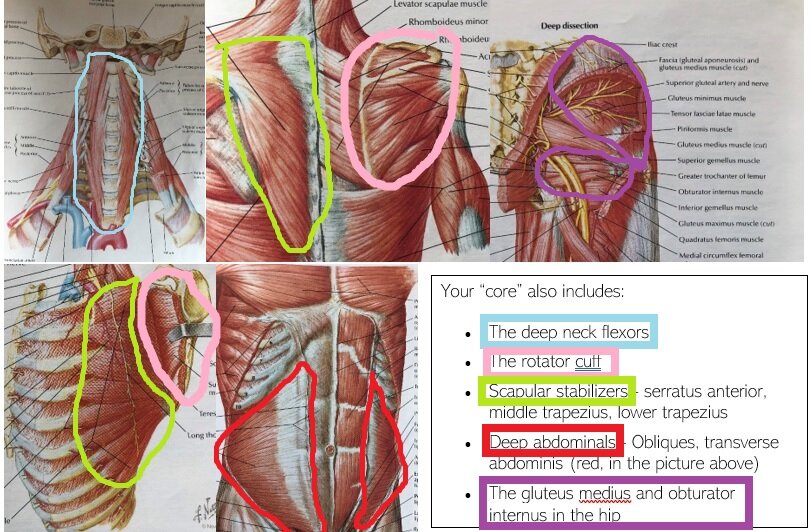
The goal isn't to create a stronger core in isolation. It's to create a movement system where your core, breathing, hips, and spine work together automatically.
Learning to activate your core is an important first step—but lasting results come from teaching your entire body to move efficiently.
In the Healthy Movement Reboot, you'll learn how your breathing, core, posture, hips, and shoulders work together to create strength, reduce unnecessary joint stress, and make movement feel easier.
Start your FREE trial today and build a healthier movement system from the inside out.
If you are hypermobile, begin building stability that you can trust! Start the first lessons FREE today!