Stiff Mid Back? 2 Simple Thoracic Spine Exercises
Stiff mid back? Tight shoulders? Neck, low back, or even hip pain that never seems to completely make sense? Your thoracic spine—the part of your spine that runs through your rib cage—may be playing a bigger role than you realize. And here's the frustrating part: You may not even feel the problem where the problem started.
A stiff or poorly moving mid back can change how your shoulders, neck, hips, and low back have to move to keep you upright. So before you stretch your neck, stretch your hamstrings, or do another round of low-back exercises, try this: Get your mid back moving first.
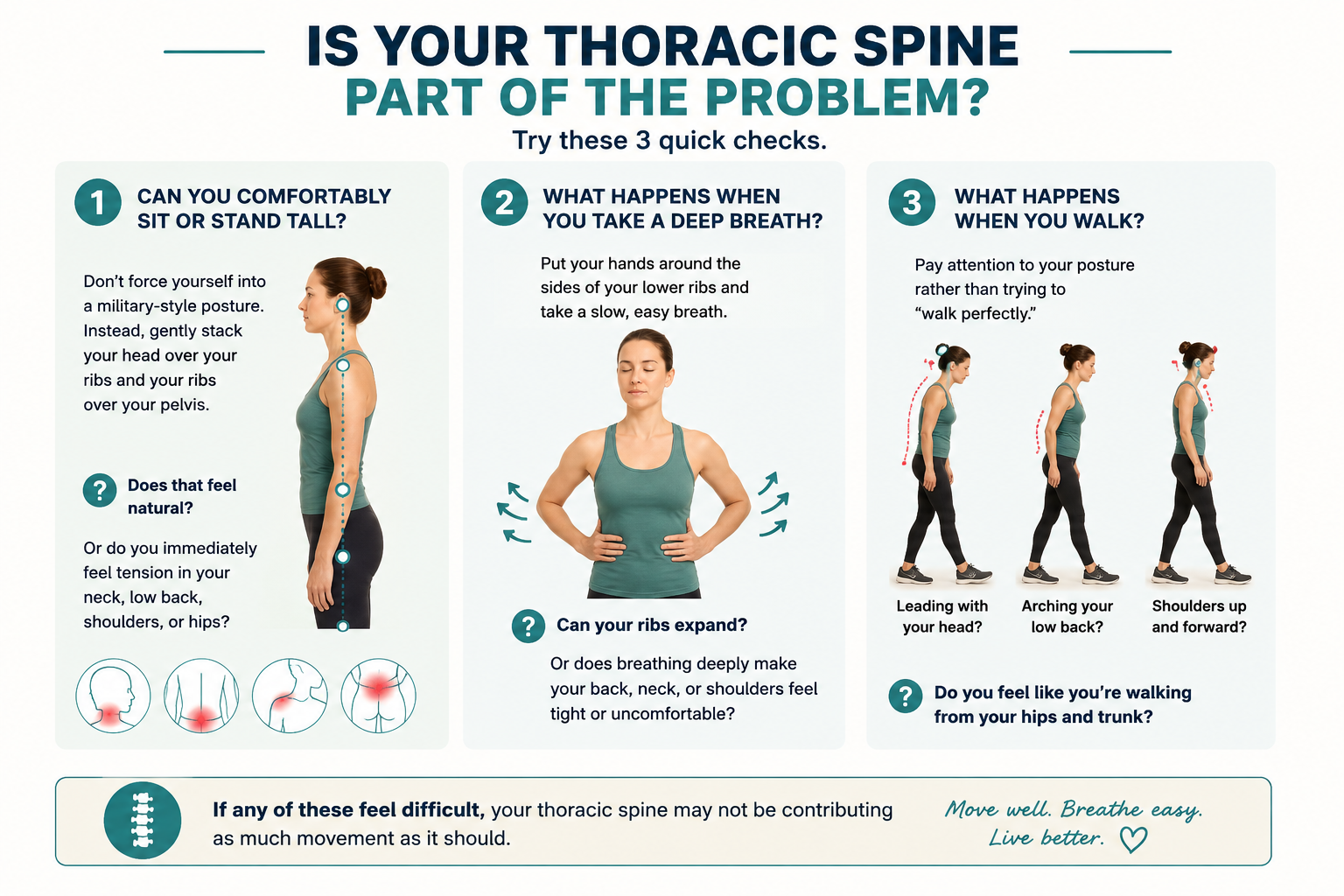
Why does your mid back matter so much?

The thoracic spine is the area of the torso that includes the rib cage and is often referred to as the mid back. The purpose of the thoracic spine is to protect your heart, lungs, stomach and liver. It also provides structural support to your torso. At the same time it also plays a big role in your movement.
Your thoracic spine sits between your neck and low back and is connected to your rib cage. That makes it an important part of the system that allows your entire body to move efficiently. When the thoracic spine becomes habitually rounded or stiff, other areas may have to compensate.
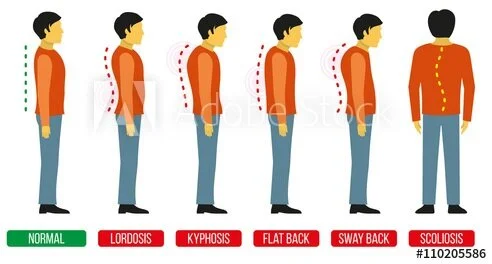
A stiff, flexed mid back can encourage:
Your shoulders to sit forward
Your head and neck to extend to keep your eyes level
Your low back to overextend
Your hips to remain in a more flexed position
Your breathing pattern to change
Your body to use extra muscle tension just to maintain an upright position
Over time, these compensations can become your body's “normal.”
That's why someone can have neck pain, shoulder pain, low-back pain, or hip pain while the mid back is actually one of the areas that needs attention.
The goal isn't simply to “stretch your back”
If your mid back feels stiff, you might instinctively try to stretch it harder but the problem isn't simply that the muscles are “tight.”. The thoracic spine can be stiff because the muscles do not engage properly or are weak. Your body may have learned to hold the thoracic spine in a particular position because of posture, breathing, weakness, movement habits, or a combination of these.
In that situation, repeatedly forcing yourself into a bigger stretch isn't necessarily the answer.
Try this 2-minute thoracic spine reset
All you need is 2 tennis balls taped together or placed inside a sock with the sock tied and a wall.

Place the tennis balls together so they create a gentle pressure on either side of your spine.
Lean your back against them against a wall.
You are not trying to crush the balls into your back.
Instead, use the wall to provide gentle leverage while you allow your mid back to move.
Spend about 2 minutes exploring comfortable movement (back and forth, side to side).
The goal is not to force a crack, stretch, or release.
Think:
Gentle pressure → easy movement → relaxed breathing.
If you find a particularly stiff area, spend a little more time there—but keep the pressure comfortable.
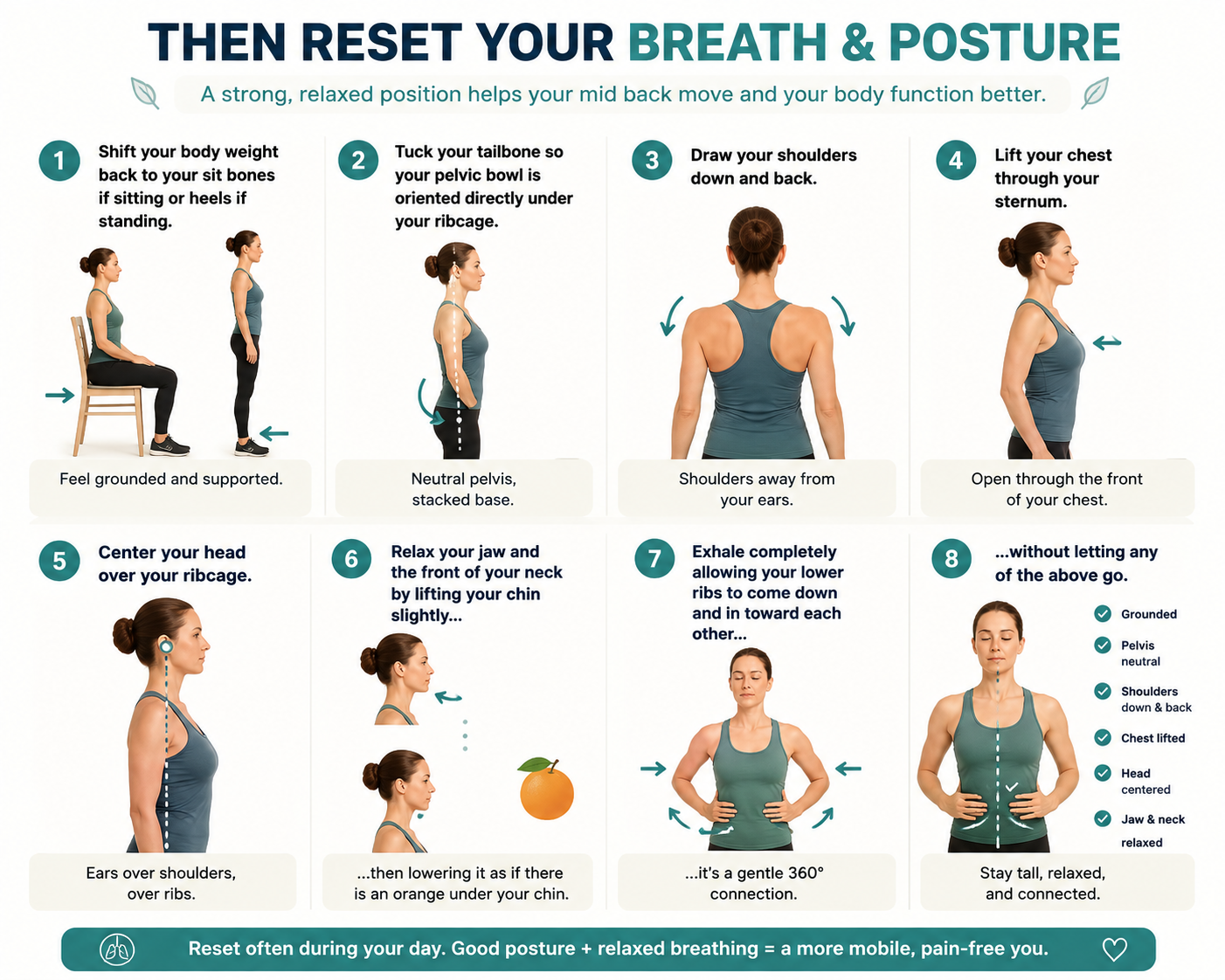
Did that help—but you still feel like your body isn't moving quite right?
The Healthy Movement Workshop helps you address the breathing, alignment, core, and movement patterns behind recurring stiffness.
If your back keeps getting stiff, look beyond the stiffness
If your mid back loosens up but keeps getting stiff again, the problem may not be mobility alone. Your breathing, core, hips, shoulders, and movement patterns all influence how your spine moves. That's why stretching the area that hurts doesn't always create lasting change. You need to change the movement pattern that keeps recreating the problem.
Your body isn't broken. Sometimes it just needs to learn a better way to move.
If you've tried stretching, strengthening, and “fixing your posture” without lasting results, my 5 Week Healthy Movement Workshop takes a different approach.
You'll learn how to improve your breathing, alignment, core activation, symmetry, and movement mechanics so your body can move more efficiently—not just add another list of exercises. Start with the first lessons FREE and see if this approach makes sense for your body.
If you're finding yourself mobilizing your back over and over, your body is telling you something. mobilizing your back can reduce symptoms, but restoring the way your body moves is what creates lasting change.
The Healthy Movement Workshop was designed to teach exactly that. Start with the free trial and learn the same corrective movement progression I use with my patients every day.